
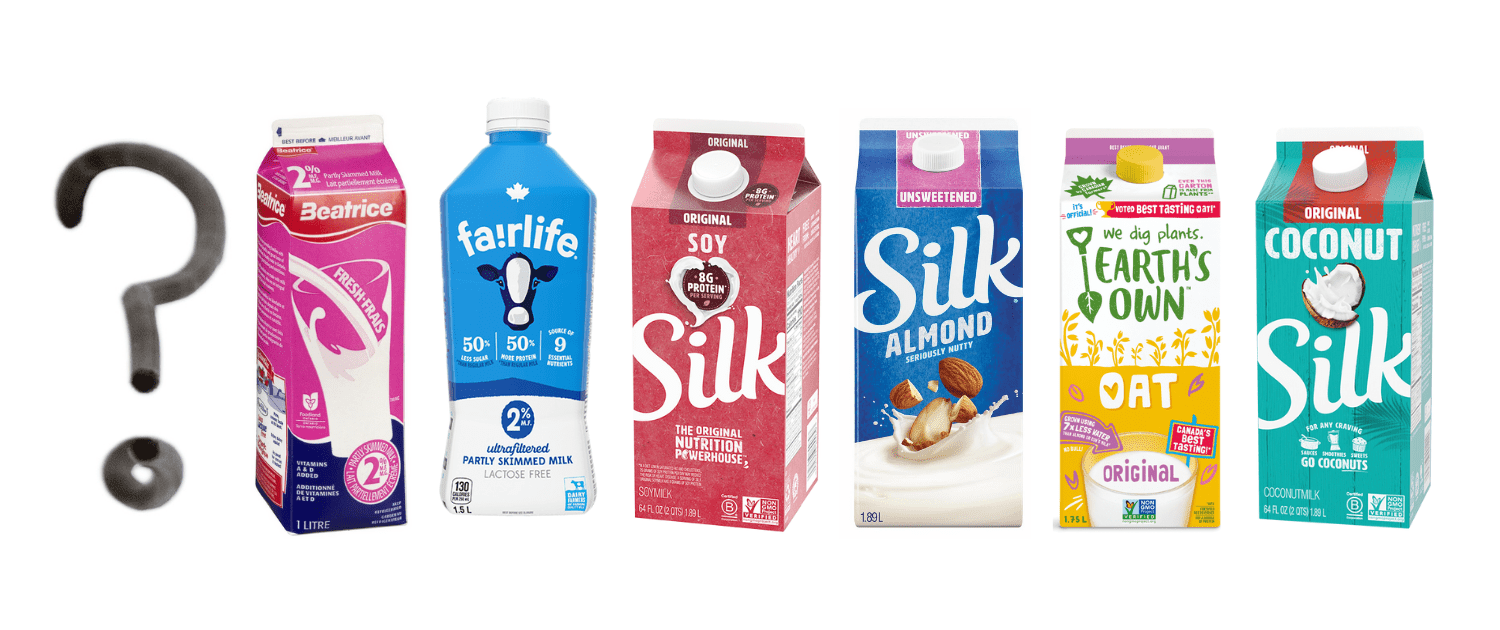
What Milk Is The Best Milk For You?
July 1, 2022 by Michael Fouts
Estimated reading time: 4 min
With food the answer is rarely that something is the ‘best.’ Rather, different foods can serve different purposes and goals.
So how do you decide what milk is the “best” for you? There are a few things to consider.
1. Dietary Restrictions
If you’re lactose intolerant, than normal cows milk is off the table for you; unless you use lactase enzyme beforehand. Also, if you’re allergic to nuts then almond and cashew milks are also off the table. This leaves you with either ultrafiltered cows milk, or one of the plant based varieties.
Do you avoid dairy due to being a vegetarian? Than stick with one of the plant based varieties.
2. Taste
Not all milks taste the same. Some can’t stand the taste of skim milk, and some prefer cows milk to almond milk. I’ve even found that amongst the same type of milks, like Ultrafiltered Chocolate Milk for example, the Fairlife brand tastes a lot better than Joyya.
Drink something that matches your taste preference.
3. Nutrient Maximization
Most milks are equally comparable and great sources of calcium and vitamin D. 1 cup gives 30% and 20% of the recommended daily calcium and vitamin D intake, respectively.
- In Canada, Cow and Soy Milk are the only milks that require fortification in Canada. If you are not drinking these, check your nutrition labels to ensure that there are 300+ mg calcium and 2+ ug/100+ IU Vitamin D
- The recommended intake for calcium, according to Health Canada, is 1000 mg for adults (19-50 years old). One cup = 300 mg. Other good sources of calcium = cheese, tofu, spinach, kale, beans, some fortified cereals (Total cereal) and fortified juices (Orange juice, if it’s fortified it will say on the label)
- The recommended intake for vitamin D, according to Health Canada, is 15 mcg/600 IU for children and adults (9-70 years old). One cup = 3 mcg/120 IU. Other great sources of vitamin D = sun exposure (In Canada, vitamin D from sunlight can only be synthesized in your skin during the spring and summer months, around midday, from 10am – 2pm, when the UV index is above 3[1]), fatty/oily fish (tuna, salmon, sardines, mackerel), beef liver, some mushrooms, and fortified food products (milk, egg yolks, yogurt, margarine, orange Juice, ready to eat cereal.
Milks are not, however, equally comparable for how much protein they offer (see table below); plant based milks not listed that are also low in protein = Cashew, Flaxseed, Hemp, and Rice.
- Why protein is important: protein is needed for growth, immunity, proper hormone function, muscles, and meal-time satiation (helps you feel full)
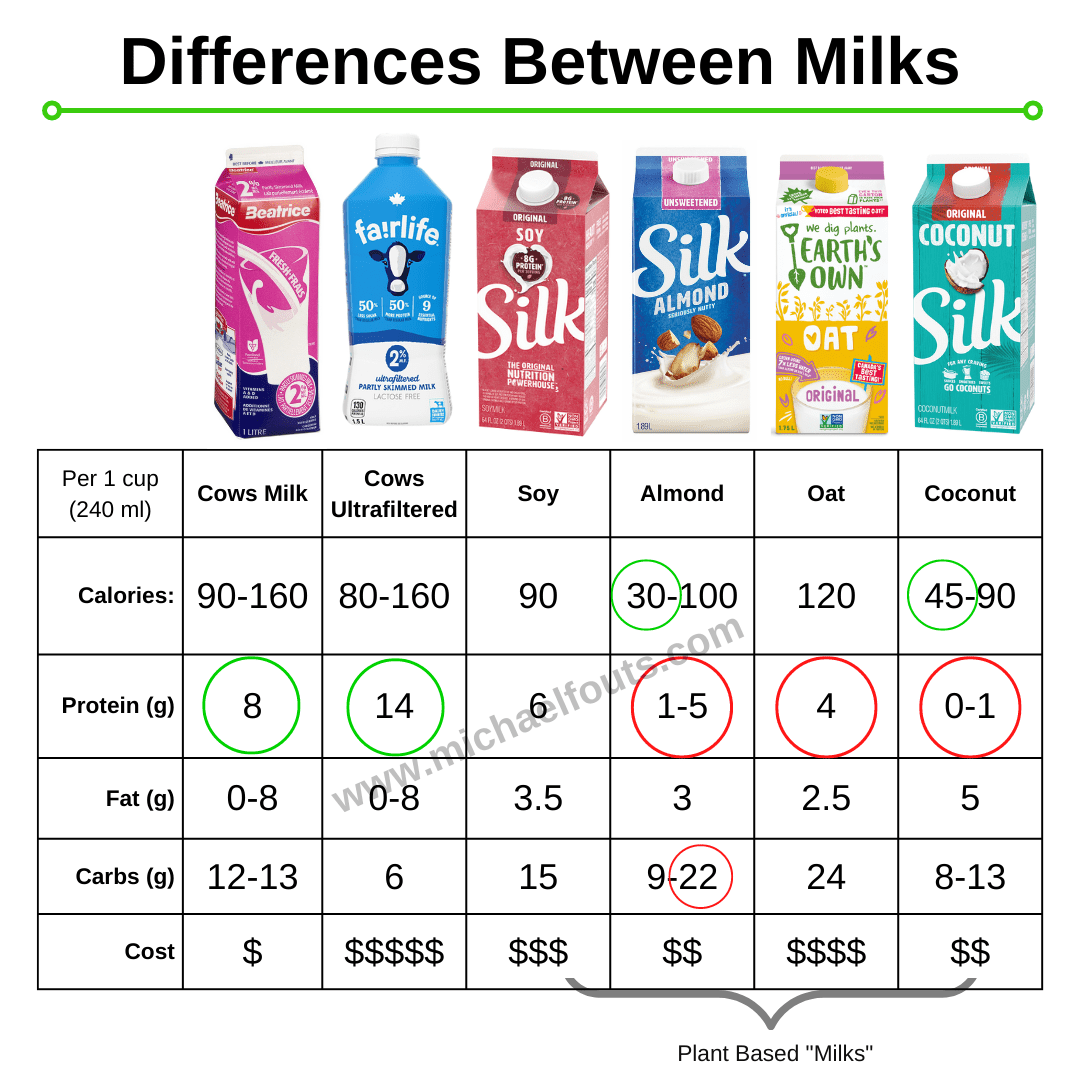
Two other things people should consider is: total calories and carbohydrates (Carbs).
With different varieties of milks, calories will range. This is due to different fat percentage (M.F.% eg. skim vs. 3.5%), filtration with ultrafiltered milk (lactose removed, protein added back), or unsweetened and sweetened varieties – with sugars or artificial sweeteners.
The lowest calorie milks are the unsweetened Almond and Coconut varieties. However, they are similar to the other milks but just have less protein. In my opinion this isn’t a worthy trade-off, unless you already have enough protein in your diet and/or taste is the reason you prefer them.
What’s about carbohydrates? Lower isn’t always the best option. If you’re looking to reduce your caloric intake, then choose milks with lower carbs. If you’re highly active, it might be to your benefit to choose higher carbohydrate milks – like chocolate milk – to replenish your muscles sugar stores (glycogen); I really enjoy Fairlife’s Ultrafiltered Chocolate Milk.
4. Price
Milk prices will vary depending on where you live, but prices (see table above) relative to each other are usually the same. Ultrafiltered cows milk is the most expensive, while cows milk is the least expensive. If you’re looking to optimize the nutrition you’re getting for how much you’re paying, cows milk is your best bet. If you can afford it, ultrafiltered is a good alternative to get more protein and less sugar.
Those who would benefit from buying ultrafiltered:
- Individuals with lactose intolerance, but like the creamy taste of milk
- Athletes who use protein shakes. Instead, replace your protein shake with 2 cups of ultrafiltered milk
- Those looking to limit sugar intake, eg. people with diabetes
- People who enjoy chocolate milk, but avoid it due to the high sugar content (only 13 g of sugar in 1 cup of ultrafiltered chocolate milk, compared to 27 g in traditional chocolate milk)
Some Common Dairy Misconceptions
Click to enlarge.
1. Saturated fat in dairy is bad for you
Saturated fat is a type of fat that is found in butter, lard, ghee, fatty meats and cheese – and some other dairy products. Saturated fat is something you want to moderate in your diet, too much can have a negative impact on your cardiovascular health.
It turns out, however, that the saturated fat from dairy doesn’t have a negative effect. It actually can have a positive effect [8, 10, 11].
As indicated by Joshua Wolrich: “The best theory as to why this is the case is that the combined effects of the structure of dairy nutrients prevent the saturated fat from being digested and absorbed properly by our gut.” Unfortunately this theory doesn’t apply to butter. The churned nature of butter changes the nutrient structure interactions [2].
Take home message: moderate your intake of saturated fat from butter, and don’t worry about your saturated fat intake from other dairy sources. But, still be mindful of having a balanced diet and understanding that higher fat percentage dairy products will have more calories, and achieving a stable body weight is important for your health.
2. Dairy causes inflammation
Saturated fat has been shown to be pro-inflammatory, and the argument goes that dairy is pro-inflammatory since it contains saturated fat. It’s true that some studies have shown saturated fat intake to be associated with low-grade inflammation [7], however in these studies there isn’t a distinction where that saturated fat comes from – like whether the saturated fat is from meat products or dairy.
This is relevant information, because two systematic reviews showed that dairy actually has an anti-inflammatory effect [8, 9]. One of these systematic reviews further stratified the results by product categories, comparing low and high fat products, and fermented products. Both low and high fat products, and fermented products were shown to be anti-inflammatory.
Take home message: dairy is not pro-inflammatory, and might even have a modest anti-inflammatory effect.
3. Hormones in milk are bad for you
One of the common objections against milk is that it contains hormones. Unless you’re injecting milk, this objection doesn’t hold it’s weight to the science of your natural digestion process. Hormones are proteins and your natural digestion process will breakdown the hormones into their basic building blocks – amino acids.
Take home message: provided you’re drinking your milk, the hormones in milk will simply be a source of protein for you and will be broken down by your body’s natural digestion.
4. Dairy causes cancer
There is simply not enough evidence to back this up. One of the arguments is that milk contains a hormone called IGF-1 (insulin-like growth factor 1) that has been known to cause cancer. As noted by Joshua Wolrich: “A glass of milk contain less than 0.015 per cent of the IGF-1 your body already produces on a daily basis” [2]. Further, as indicated in the above “Hormones in milk are bad for you,” this hormone will get broken down by your body (provided you’re gut and liver are working well, and that you’re ingesting and not injecting it).
Another argument about dairy causing cancer is: “Dairy acidifies the body and therefore increases the the risk of cancer.” Those that know human physiology knows that food and drink simply cannot change the pH of your body in this way.
Take home message: there is no evidence that dairy can cause cancer. Further, it’s very unlikely that any one food group, aside from ingesting known carcinogens (like alcohol), causes cancer in isolation. Cancer is a complex disease that is affected by many other factors, like our genetics, sleep quality, and stress management to name some of the biggest factors.
Why dietary guidelines still recommend consuming ‘low-fat’ dairy?
There are a few reasons, but my personal opinion is: public’s trust of dietary guidelines.
It takes time for dietary guidelines to change. If dietary guidelines were changed reactively to emerging research we’d likely run into a scenario where changes would be made prematurely, and then subsequently reversed. This would lose the publics trust in the dietary guidelines, and therefore is largely why dietary guideliness are slower to change.
Other reasons indicated by Joshua Wolrich [2[:
- “It’s potentially difficult to communicate the differences between butter and other types of dairy at a population level without risking confusion.”
- “Our narrow-minded simplistic view of weight gain has led to public health advisors labelling full-fat dairy as a risk for making people fat, despite the fact that recent research shows the exact opposite to be true.”
Main Highlights:
- Calories will range based on %M.F. chosen (skim, vs. 3.5%), Ultrafiltered (lactose removed), and sweetened vs. unsweetened; lowest calories are the unsweetened Almond and Coconut varieties, however they are similar to the other milks but with just less protein (worthy trade off?)
- Cow Milk varieties have the highest protein content; plant based milks not listed that are low in protein: Cashew, Flaxseed, Hemp, and Rice
- All milks are good sources of Vitamin D and Calcium due to fortification
- Cost (highest to lowest): Cows Ultrafiltered > Oat > Soy > Almond & Coconut > Cows
- Saturated fat from Dairy is fine (minus butter), and the overall composition of foods rather more than any one individual nutrient
- Dairy is not pro-inflammatory. At worst, it’s non-inflammatory. At best it’s anti-inflammatory
- Hormones in dairy will be degraded by your body’s natural digestion process
- Dairy doesn’t cause cancer
Till next time,
-Mike
- https://mssociety.ca/library/document/38cuveX9sSrF0QEZ1DfOMUaBilKTyRJk/original.pdf
- Joshua Wolrich. “Food Isn’t Medicine.” Apple Books.
- Mero A et al. ‘IGF-I, IgA, and IgG responses to bovine colostrum supplementation during training.’ Journal of Applied Physiology 93 (2002) 732–739.
- Mach F et al. ‘2019 ESC/EAS Guidelines for the management of dyslipidaemias: lipid modification to reduce cardiovascular risk.’ European Heart Journal 41 (2020) 111–188.
- Hooper L et al. ‘Reduction in saturated fat intake for cardiovascular disease.’ Cochrane Database of Systematic Reviews (2020).
- Thorning TK et al. ‘Whole dairy matrix or single nutrients in assessment of health effects: current evidence and knowledge gaps.’ The American Journal of Clinical Nutrition 105 (2017) 1033–1045.
- Santos S, Oliveira A & Lopes C. ‘Systematic review of saturated fatty acids on inflammation and circulating levels of adipokines.’ Nutrition Research 33 (2013) 687–695.
- Drouin-Chartier J-P et al. ‘Systematic review of the association between dairy product consumption and risk of cardiovascular-related clinical outcomes.’ Advances in Nutrition 7 (2016) 1026–1040.
- Bordoni A et al. ‘Dairy products and inflammation: A review of the clinical evidence.’ Critical Reviews in Food Science and Nutrition 57 (2017) 2497–2525.
- Larsson SC, Crippa A, Orsini N, Wolk A & Michaëlsson K. ‘Milk consumption and mortality from all causes, cardiovascular disease, and cancer: a systematic review and meta-analysis.’ Nutrients 7 (2015) 7749–7763.
- Trieu K, et al. Biomarkers of dairy fat intake, incident cardiovascular disease, and all-cause mortality: A cohort study, systematic review, and meta-analysis.Trusted Source PLoS Medicine, 2021.
You might also like:
 https://www.michaelfouts.com/wp-content/uploads/2017/10/Fodd-you-should-not-eat-before-exercise-2.jpg
540
1080
Michael Fouts
https://www.michaelfouts.com/wp-content/uploads/2017/06/logo100-1-1.jpg
Michael Fouts2022-11-16 08:00:342022-11-16 11:52:54How Much Protein Do You Need Per Day?
https://www.michaelfouts.com/wp-content/uploads/2017/10/Fodd-you-should-not-eat-before-exercise-2.jpg
540
1080
Michael Fouts
https://www.michaelfouts.com/wp-content/uploads/2017/06/logo100-1-1.jpg
Michael Fouts2022-11-16 08:00:342022-11-16 11:52:54How Much Protein Do You Need Per Day? https://www.michaelfouts.com/wp-content/uploads/2020/06/Blog-Cover-1500px-×-630px-1.png
630
1500
Michael Fouts
https://www.michaelfouts.com/wp-content/uploads/2017/06/logo100-1-1.jpg
Michael Fouts2021-09-02 10:44:532021-09-02 21:09:42Adept at Adapting – Metabolic Down-Regulation During a Diet
https://www.michaelfouts.com/wp-content/uploads/2020/06/Blog-Cover-1500px-×-630px-1.png
630
1500
Michael Fouts
https://www.michaelfouts.com/wp-content/uploads/2017/06/logo100-1-1.jpg
Michael Fouts2021-09-02 10:44:532021-09-02 21:09:42Adept at Adapting – Metabolic Down-Regulation During a Diet https://www.michaelfouts.com/wp-content/uploads/2021/08/Blog-Cover-1500px-×-630px.png
630
1500
Michael Fouts
https://www.michaelfouts.com/wp-content/uploads/2017/06/logo100-1-1.jpg
Michael Fouts2021-08-18 21:22:262024-09-25 08:33:47Your Fitness Is A Metric Of Your Health, Not Your Physique
https://www.michaelfouts.com/wp-content/uploads/2021/08/Blog-Cover-1500px-×-630px.png
630
1500
Michael Fouts
https://www.michaelfouts.com/wp-content/uploads/2017/06/logo100-1-1.jpg
Michael Fouts2021-08-18 21:22:262024-09-25 08:33:47Your Fitness Is A Metric Of Your Health, Not Your Physique
